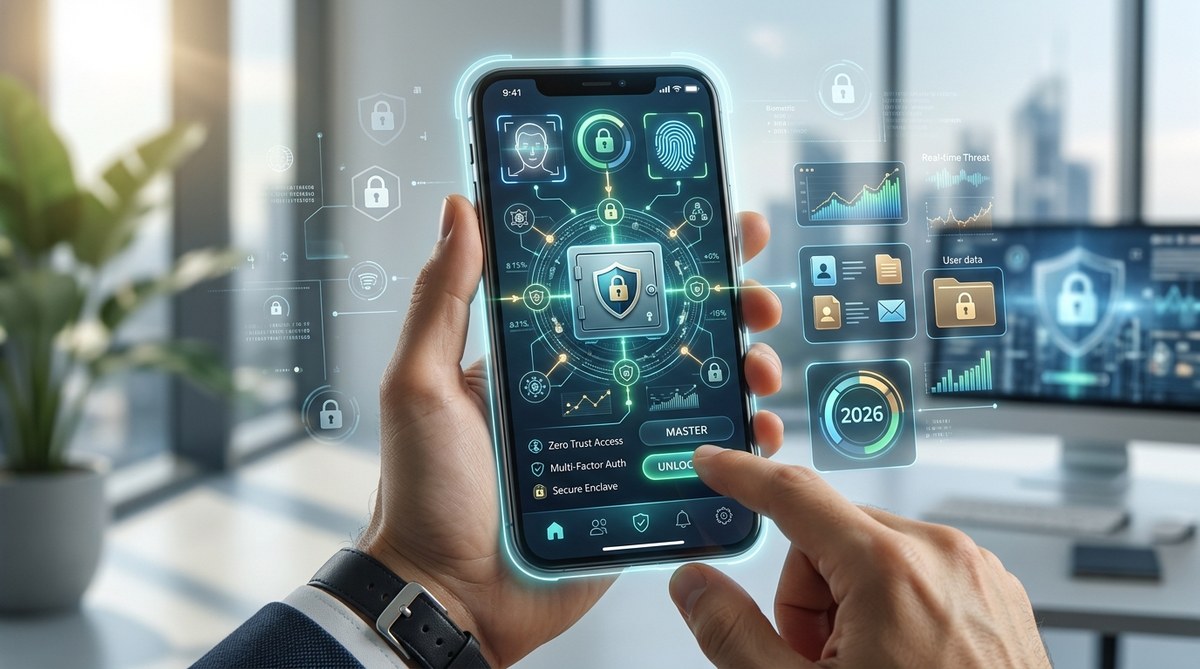
Mobile app security in 2026 has become more sophisticated than ever. As cyber threats grow smarter and more targeted, developers and security teams must stay updated on the latest protections. Whether you’re safeguarding user data, preventing unauthorized access, or ensuring compliance, understanding the newest mobile app security features is essential. This guide walks through the most effective strategies and innovations shaping the mobile security landscape this year.
In 2026, mobile app security relies heavily on AI-driven defenses, biometric authentication, and zero-trust architectures. Staying updated on these features helps protect sensitive data from the latest cyber threats.
What Are The Latest Mobile App Security Features In 2026?
The landscape of mobile security continues to evolve rapidly. With new threats emerging daily, app developers and security professionals need to integrate advanced protections into their workflows. Here are some of the most impactful features and practices shaping mobile security this year.
AI-Powered Threat Detection and Response
Artificial intelligence (AI) has become a cornerstone of mobile security in 2026. Modern AI algorithms can analyze vast amounts of data in real time, spotting anomalies that may indicate malicious activity. These systems can automatically respond to threats, such as blocking suspicious login attempts or flagging unusual app behavior.
For example, AI-driven behavior analysis can detect sophisticated phishing attacks or malware infiltration attempts that traditional defenses might miss. This proactive approach helps organizations stay one step ahead of cybercriminals.
Biometric Authentication Advances
Biometrics remain a trusted method for securing mobile apps. In 2026, biometric features have advanced to include multi-factor biometric authentication. Instead of relying solely on fingerprint or facial recognition, apps can combine several biometric factors—such as voice, iris scans, or even behavioral biometrics—to enhance security.
These multi-layered biometric protections make unauthorized access significantly harder. They also improve user experience by providing quick, seamless authentication that is difficult for attackers to replicate.
Zero-Trust Security Architecture
A zero-trust approach is now standard in mobile security strategies. This model assumes no device or user is inherently trustworthy. Every access request undergoes strict validation, regardless of whether it originates inside or outside the network.
Implementing zero-trust involves continuous verification, identity-based access controls, and micro-segmentation. For mobile apps, this means only granting permissions on a need-to-know basis and constantly monitoring activity for suspicious behavior.
End-to-End Encryption Enhancements
End-to-end encryption (E2EE) remains vital for protecting data in transit. In 2026, encryption algorithms have been strengthened, including the adoption of quantum-resistant cryptography. This prevents attackers equipped with quantum computers from deciphering sensitive information.
Apps now automatically encrypt data stored locally and during transmission. This layered encryption significantly reduces the risk of data breaches and interception.
Secure Over-the-Air Updates
Updating apps securely is crucial. Mobile app stores now require cryptographically signed updates, ensuring authenticity and integrity. Additionally, over-the-air (OTA) updates employ encrypted channels and secure boot processes to prevent tampering.
This means vulnerabilities can be patched promptly without exposing users to risks, and attackers cannot insert malicious code during the update process.
Privacy-Preserving Technologies
User privacy remains a top priority. In 2026, apps leverage technologies like differential privacy and federated learning. These methods enable data collection and analysis without exposing personal information.
For instance, federated learning allows models to be trained locally on devices, sharing only aggregated insights back with developers. This minimizes the risk of data leaks while maintaining useful analytics.
Advanced App Locking and Access Controls
App locking features have become more flexible. Users can now set time-based or context-aware locks, such as requiring face recognition after a certain period or when the device is in a specific location.
Developers incorporate these features to protect sensitive parts of their apps, such as banking details or personal health data, from unauthorized access.
Implementing Mobile Security Features in 2026
To maximize protection, security professionals and developers should follow these steps:
- Prioritize AI integration: Use AI tools that analyze app behavior and network traffic to spot threats early.
- Enhance biometric methods: Adopt multi-factor biometric authentication for critical app features.
- Enforce zero-trust policies: Validate each access request constantly, regardless of the user’s location or device.
- Strengthen encryption: Implement quantum-resistant encryption protocols for data at rest and during transmission.
- Secure update channels: Use cryptographically signed updates and encrypted OTA channels to prevent tampering.
- Leverage privacy technologies: Incorporate federated learning and differential privacy to protect user data.
- Use robust app locking: Implement flexible locking mechanisms that adapt to user behavior and context.
Practical Processes for Developers
- Assess current security measures to identify gaps.
- Integrate AI threat detection tools into your development pipeline.
- Update authentication protocols to include multi-factor biometric options.
- Implement end-to-end encryption with the latest cryptography standards.
- Test app update workflows for security and integrity.
- Educate your team on privacy-preserving techniques.
- Monitor app activity continuously post-deployment for anomalies.
Common Mistakes to Avoid
| Technique | Mistake | Consequence |
|---|---|---|
| Using outdated encryption algorithms | Data can be decrypted by attackers | Data breach and loss of user trust |
| Relying solely on passwords | Increased risk of theft or guessing | Unauthorized access |
| Ignoring device security posture | Devices become entry points | Larger network compromise |
| Failing to validate third-party libraries | Vulnerabilities in dependencies | Exploits and malware infections |
| Not updating apps regularly | Known vulnerabilities remain open | Increased attack surface |
“Implementing layered security with AI, biometric authentication, and encryption is no longer optional. In 2026, these features collectively build a resilient defense against sophisticated threats.”
— Cybersecurity expert Jane Doe
Securing Mobile Apps for a Safer Future
Staying on top of mobile app security features in 2026 means adopting a proactive mindset. Combining AI-powered detection, advanced biometrics, zero-trust models, and privacy-preserving tech creates a comprehensive shield for user data. Regularly reviewing your security measures and responding swiftly to new vulnerabilities will keep your apps resilient.
Remember, cybersecurity is a journey. As threats evolve, so must your defenses. Incorporate these features and best practices into your development process to protect your users and your reputation.
Final thoughts on staying ahead in mobile security
Adapting to the latest mobile app security features in 2026 isn’t just about technology. It’s about fostering a security-first mindset across your team. Prioritize user privacy and data protection at every step. With the right tools and strategies, you can create apps that are not only functional but also trustworthy.
Embrace these innovations today to build robust mobile applications that stand strong against the cyber threats of tomorrow.